Market Entry Strategy

Which market is
actually worth the effort?

Fifty-four African markets, plus the European Union. Most of them are wrong for your product, too distant, too competitive, too expensive to reach, or already served by someone closer. Market entry strategy is the discipline of eliminating them honestly, then building a credible route into the two or three that survive.

The problem

Most market choices are
made by anecdote

A market gets chosen because someone met a distributor at a trade fair, because a relative lives there, or because a headline said the sector was growing at nine percent. Sometimes that works. More often the tariff advantage turns out to be unusable, the payment cannot be repatriated, or the transit time destroys the product before it arrives.

The alternative is not more research for its own sake. It is a short, structured elimination against criteria that actually determine whether a shipment is profitable, applied to a defined list of candidate markets, scored, and reduced to a shortlist you can defend to a board or a lender.

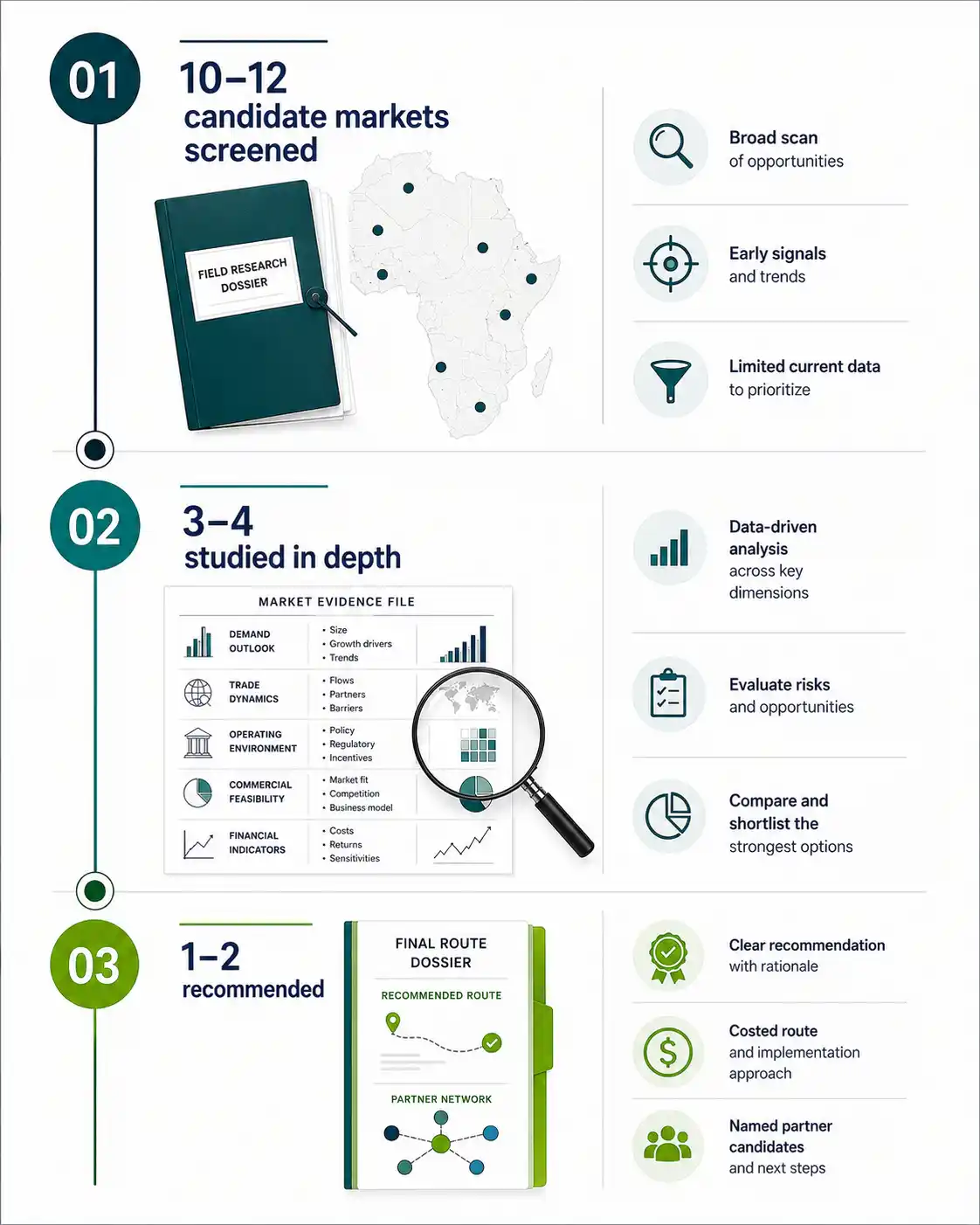
Stage one

Eight screening criteria

Applied to every candidate market before any of them receives detailed study. A market that fails on payment or logistics is eliminated regardless of how attractive the demand looks.

Demand and price

Real import volumes for your HS heading, the prices those imports clear at, and whether your cost base survives them.

Preference margin

What duty you would actually pay, and whether AfCFTA or another arrangement produces a saving you can genuinely claim and evidence.

Non-tariff barriers

Standards, registration, licensing, quotas and inspection regimes, usually a larger obstacle than the tariff itself.

Payment and currency

How you get paid, in what currency, at what conversion cost, and whether settlement channels between the two countries actually function.

Logistics and transit

Realistic cost per ton and door-to-door transit time, including border dwell, not the carrier’s advertised schedule.

Distribution depth

Who already reaches your end customer, how many layers sit between, and what margin each layer takes.

Competition

Incumbents, their origin, their cost advantage, and whether they hold contractual or relational lock-in you would have to break.

Regulatory burden

Product registration, local representation requirements, labelling language, and the time and cost of obtaining approval to sell.

Trade finance & FX

Payment instrument and terms, bank domiciliation of the export contract, and the exchange-control obligations attaching to the proceeds.

Stage two

Choosing a route to market

The market decision and the route decision are separate. The same country can be commercially viable through a distributor and hopeless through direct export, or the reverse.

Route Works When The Cost of It
Direct export You have an identified buyer, sufficient volume per shipment, and the internal capacity to handle documentation and after-sales yourself. Highest margin, highest administrative load, and all the credit risk sits with you.
Distributor The market needs local stock, local credit terms and a local face; volumes justify someone carrying inventory. You surrender price control and customer visibility, and a weak distributor is difficult to replace once registered.
Commission agent You want market presence without giving up title to the goods, or you are testing demand before committing. Lower cost and lower commitment, but the agent rarely invests in building your brand.
Joint venture or local partner Regulation requires local participation, or the partner brings distribution and relationships you cannot buy. Slowest to establish, hardest to exit, and governance is where most of these fail.
Local finishing or assembly Duty structures reward transformation in-market, or origin rules make local processing the difference between preference and full duty. Capital commitment and a much longer payback, but it can change the tariff treatment entirely.
Platform and e-commerce Product is high-value, low-volume, and the customer is willing to buy without touching it first. Fulfilment and returns across borders are usually harder than the selling.

Corridor realities we build into the model

A market study written from trade statistics alone will recommend routes that do not function. These are the conditions that change the answer.

Context

Gateway capacity

Douala and Kribi handle most CEMAC volume. Berth availability, handling capacity and yard dwell affect landed cost more than freight rates do.

Landlocked transit

The corridors serving Chad and the Central African Republic carry real costs in escort, delay and informal payment. These belong in the model, not a footnote.

Nigeria proximity

The largest nearby market sits across a border where a substantial share of trade moves informally. Formalizing that flow is an opportunity and a compliance question at once.

Payment and settlement

Whether the pair of countries can settle in local currency, and what the alternative costs in conversion and delay, frequently decides which market is viable.

Language and documentation

Francophone and Anglophone markets differ in documentation practice, contract convention and negotiating norms. We work in both and account for the friction between them.

The document stack

What you receive

  • Scored market shortlist — every candidate market ranked against the eight criteria, with the reasoning for each elimination recorded.
  • Country brief per finalist — demand, tariff and preference position, barriers, competitors, distribution structure and registration requirements.
  • Landed cost model — built per Incoterm, so you can see where margin is created and where it disappears.
  • Route-to-market recommendation — with the trade-offs stated plainly, not just the preferred option.
  • Qualified partner longlist — named distributors, agents or buyers, with an approach strategy and outreach materials in the appropriate language.
  • Twelve-month entry plan — sequenced milestones, owners, budget and the decision points at which you should stop
A business analyst reviews a colorful bar chart and documents at a desk, indicating data analysis.

Questions

Before you commit